












 |
Sunday, 31 July 2005
Sunday Blogging
From the Baptist Hymnal, 1975 Edition:
God of earth and outer space,
God of love and God of Grace,
Bless the astronauts who fly
As they soar beyond the sky.
God who flung the stars in space,
God who set the sun ablaze,
Fling the spacecraft thro' the air,
Let man know your presence there.
(Words, Thad Roberts, Jr., Copyright 1970 by The Hymn Society of America.)
One More Day
 Per Spaceflight Now:
NASA's mission management team today extended the shuttle Discovery's flight by one day, giving the astronauts more time to assist and resupply the international space station's two-man crew, and concluded the shuttle's heat-shield tiles and insulation blankets are fit for a normal re-entry Aug. 8.
Saturday, 30 July 2005
Eight, Nine Or Ten?

Well, the other shoe has dropped.
First, there was Quauor, the large Kuiper Belt Object discovered recently that raised the discussion about what exactly, in our solar system, should be considered a planet. Quauor, though, was small enough that it obviously wasn't going to make the cut-off, so the issue remained academic at that point.
Then, there was Sedna, a KBO significantly larger than Quauor, but still smaller than Pluto. The discussion was raised again, but was taken seriously at this point only by those wanting a change.
Now, though, there is 2003UB313. And the issue can no longer be ignored.
2003UB313, while still a KBO, and much more than twice as distant as Pluto, has the distinction of being larger than Pluto.
The story on the front page of NASA.gov says outright that 2003UB313 is a planet, though a formal decision has yet to be made:
The planet is a typical member of the Kuiper belt, but its sheer size in relation to the nine known planets means that it can only be classified as a planet, Brown said.
It seems to me, though, that's not the only option. In my mind, there are at least three possibilities:
- There are eight planets. End the solar system with Neptune. Everything up through Neptune is a planet; everything beyond is a KBO, including Pluto, Quauor, Sedna and 2003UB313. Sad for Pluto, but probably the most practical solution, particularly since it saves making this decision every time a new large KBO is identified, which could easily be increasingly frequently. (One issue it raises, though, is what to do about Mercury on the off-chance that a KBO is discovered that is larger than the innermost planet.)
- There are nine planets. Period. Decide that Pluto is grandfathered in, but cut the list off there. No real scientific basis for this one; it has more to do with sentimental factors. That, really, are kind of irrelevant -- while almost everyone around today pretty much takes Pluto for granted, in the history of our knowledge of the solar system, the 75 years that we've known about Pluto is really not significant.
- There are ten (or more) planets. Pluto stays in the solar sytem, so 2003UB313, being larger, makes the list, too. And so, presumably, does anything else larger than Pluto discovered later. This route really needs for the International Astronomical Union to finally decide formally what the guidelines for planethood are, rather than just deciding it on a case-by-case basis. The only difference between 2003UB313 and Sedna is size, so where exactly is the line. Obviously, the cut-off can't be higher than Pluto, but is there any rationale for making Pluto the lower limit other than, again, sentimental reasons? The rocky planets and the gas giants are clearly different than other bodies in the solar system, but the only difference between KBOs and Kuiper Belt Planets (KBPs, I suppose?) would be an arbitrary size limit.
I did think this part of the story was interesting, though:
A name for the new planet has been proposed by the discoverers to the International Astronomical Union, and they are awaiting the decision of this body before announcing the name.
If 2003UB313 does become a planet, when the name is announced, Blogpoints will be awarded for the best mnemonic devices for remembering the new solar system.
For the sake of full disclosure, though, I do have to admit it was kind of exciting to read that the tenth planet had been found.
A Future Yet
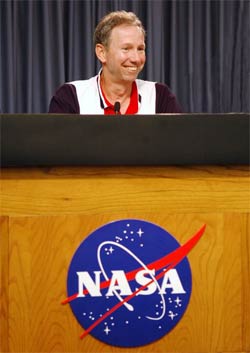 Per Spaceflight Now:
NASA Administrator Michael Griffin mounted a spirited defense of the shuttle program and the beleaguered external tank project today, saying virtually all of NASA's post-Columbia improvements to the huge tank worked as expected during Discovery's launching Tuesday. While at least three relatively large pieces of foam debris fell away from the tank during ascent, Griffin said he's confident engineers will develop a fix and that flights will resume sooner rather than later.
...
"Discovery is the cleanest bird we've seen," Griffin said, referring to the overall number of dents, dings and chips seen in the shuttle's heat-shield tiles. "Six times cleaner than the average across 113 (previous) missions. So the fact that we have three or four things that we still need to clean up from our first test flight in two-and-a-half years - I'm not a spin kind of a guy, you all know that - but in the world of engineering, we did pretty well."
...
Griffin agreed NASA "missed" the threat posed by the PAL ramp foam, "but to extrapolate from that fact and say that we can't fix it, I think is just a bridge too far. I think we're going to fix it, I think we're going to fix it in short order, we're going to get back flying. All we ever said the other day was that we are not going to fly again until we fix it. And I think that's the right thing to do. But we don't expect this to be a long, drawn-out affair, to be honest with you. If that changes, we'll tell you, but that's what we're looking at now."
Friday, 29 July 2005
That Our Flag Was Still There...
A while back, I posted something about "The Empty Flagpole," a flagpole at Marshall that is used solely to fly flags representing the Orbiters only when one of the Shuttles is in space; a flagpole that had been unused for almost two and a half years.
Today, though, a flag is flying there. I finally made it over to see it, and I was glad I did. Somehow, with everything going on -- the concerns about the launch, the uncertainty about the future -- it was reassuring to see that flag flying. It was something of a Francis Scott Key moment, and my mind began to
 Oh, say can you see,
In the void’s endless night
What so proudly we launched
On that bright Tuesday morning?
Whose bold thrust and brave crew
Did return us to flight,
While new worlds await,
A new era aborning?
And the rockets’ red glare,
The foam falling through air
Gave proof through their flight
Just how bravely they dare!
Oh, say does our Shuttle Discovery yet soar,
As we fly once again, and once more we explore?
Editorial Note
From The New York Times:HOUSTON, July 28 - Clara Olvera has worked in the cafeteria at the Johnson Space Center here for only a year, but on Thursday afternoon she could detect a shift in the mood of the engineers, astronauts and administrators who come in for lunch each day. The grounding of shuttle flights because of another pesky foam problem, she said, was clearly weighing on spirits.
"You can see it in their faces," Ms. Olvera said, wiping tabletops after the lunchtime rush. "It's been a very emotional week, after reaching the goal on Tuesday only to have it all turn around so quickly. We can only hope for the best."
The mood elsewhere around NASA's manicured campus, and in the restaurants, hotels and bars outside the center along Nasa Road 1, also stood in contrast to the euphoria that had accompanied the launching of the shuttle Discovery just two days earlier. It was clear that some NASA employees, and others who depend on the agency for their livelihood, had been hoping for the celebrations to continue after waiting more than two years for a launching in the wake of the Columbia disaster.
"There's disappointment in the back of people's minds," Charla Stuart, a NASA education program specialist, said of the grounding, although, referring to the program's astronauts, she added, "We need to remember these are people's lives we're talking about."
Happy Anniversary!
 Happy 20th Anniversary to Arlo and Janis, one of my all-time favorite comic strips!
Thursday, 28 July 2005
Godspeed, Discovery!
 This week's new Hatbag is online.
The Sleeper Awakens!
 Wow!
Wow!There's two day's worth of new blogging over at Taking A Nap, after five months of dormancy!
Go, check it out! Joe's back, and he's pissed!
The Future
 I've seen only a couple of stories along this line today. I've discounted similar pieces since the loss of Columbia, but I'm beginning to wonder if it may be true this time.
Tuesday may have marked the last launch of the Space Shuttle.
Hopefully, that will turn out not to be the case. Hopefully, the cause of debris shedding can be identified quickly, and the problem can be repaired quickly, simply and cheaply. Hopefully, Atlantis will launch on schedule in September.
But, at this point, I really wonder how much time, money and effort it could require to get the fleet flying again before the administrator decides it's not worth it. Mike Griffin has made it very clear that he's not a big fan of the Shuttle, and wants to retire the Orbiters as quickly as is reasonably possible. He also has made it clear that his main priority is moving ahead with execution of the Vision, and is willing to make cuts to bring that about quickly. It's not impossible to imagine a scenarion in which Griffin would decide that the cost and effort needed to get the Orbiters flying again would be better invested in new launch systems.
Agency officials have already said that the Shuttle may not fly again this year. Beyond that, only time will tell.
Virgin Honeymoon
 Per Space.com:
At the Experimental Aircraft Association’s (EAA) AirVenture gathering being held in Oshkosh, Wisconsin yesterday, Sir Richard Branson, founder of Virgin Galactic, announced that George Whitesides, the Executive Director of the National Space Society and his bride-to-be, Loretta Hidalgo, will be the first honeymoon couple to take a trip on the fledgling space tourism company’s sub-orbital craft when the company goes into operation.
Branson brought the couple on stage Tuesday night during an airshow gala event sponsored by Virgin Galactic, there he gave them a bottle of champagne and a pin to signify their future Virgin Galactic space trek.
“Loretta and I have tickets to be the first honeymoon couple on the Virgin Galactic service. It’s not going to happen for a few years, but it’s something we’ve been thinking about for a long time,” Whitesides told SPACE.com in a phone interview.
“We have put money down. We think the Virgin Galactic team is terrific. There’s a bunch of great groups out there…and I hope they’ll all succeed,” he added.
While Virgin Galactic suborbital operations are still several years away, Whitesides said he’s looking forward to his honeymoon trip into space.
And will they hold hands on liftoff? “You bet,” Whitesides said.
Together At Last!
The Space Shuttle Discovery has docked with the International Space Station, and the nine people now in space have begun joint operations.So far, the checks of Discovery's thermal protection system have shown no problems. According to Administrator Mike Griffin: "We continue to examine the data but at this point, we think Discovery is a clean bird."
Videopod Update
 BusinessWeek has an article on the rumors that Apple will soon be announcing a video iPod, in which they make the argument that while an iPod with video-playing capability may be coming, a separate handheld video device shouldn't be expected.
I'm not sure that I completely buy into their case. I don't know that Jobs has ever said that Apple wouldn't make such a device; I believe what he's said is that's not what the iPod is about. I also don't know that, as they argue, the fact that all iPods now have color screens means that there wouldn't be a market for a video device.
iPhone Update
 So the Motorola iTunes phone will be revealed next month.
No, we really mean it this time.
Honestly.
Stop laughing.
Grounded
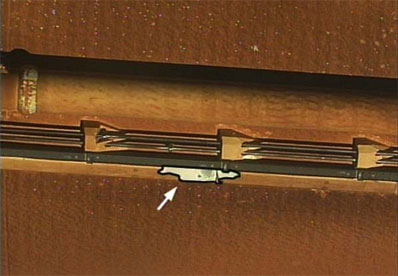 Due to the concerns about ET foam shedding during Wednesday's launch, the Shuttle fleet is once again grounded until the problem can be resolved.
Wednesday, 27 July 2005
Watching Through Windows
 Per Globe and Mail:
The next time you visit the website of Microsoft Corp. to download some software, be prepared to let the world's biggest software company have a look inside your computer.
In a determined strike to quell the proliferation of counterfeit software, beginning today, Microsoft will require that all customers coming to its website for upgrades and other downloads submit their computers to an electronic frisking.
Russian Around
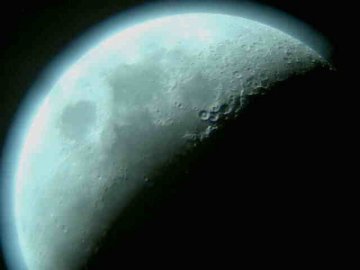 Per Cosmic Log:
Russian space officials are working out a plan to send high-rolling space passengers around the moon and back for a cool $100 million.
And just as the Soviet space shuttle looked like the American version, this idea has much in common with an American company’s proposal to use the international space station and a beefed-up Soyuz craft to offer an Apollo 8-style translunar excursion.
Debris Events
 Spaceflight Now has an article giving background on the "debris events" during yesterday's launch of Discovery. It sounds like two of the three pose basically no risk, but I have yet to see a definitive analysis of the loss of the forward heat shield tile.
Addendum: Here's more info.
Parsons Profile
Tuesday, 26 July 2005
Go!

Very Last RTF Update
And we have, in fact, returned to flight.The sidebar has been updated to reflect that two more people have now been into space and that the STS-114 crew is now on orbit, and the launch countdown, at long last, has been taken down.
This concludes over two years of ATW RTF coverage.
Apple-Free World

iPhone Update
So unless I just missed it, there hasn't been an announcement of Motorola's iTunes phone.
RTF Update
Perhaps today?The entire crew is boarded, buckled and waiting, meaning that we are now further along in launch preparations than ever before.
Weather conditions are currently go for launch.
At this writing, it is one hours, 40 minutes until the scheduled launch.
Godspeed Discovery and the STS-114 crew!
Monday, 25 July 2005
RTF Update
I just watched the countdown clock on the blog tick away to less than one day until launch.At this point, everything is go for launch.
As of this writing, we're at 23 hours, 57 minutes. And counting.
In The House
 Per Space.com:
The House Friday overwhelmingly endorsed President Bush's vision to send man back to the moon and eventually on to Mars as it passed a bill to set NASA policy for the next two years.
The bill passed 383-15 after a collegial debate in which lawmakers stressed their commitment to not just Bush's ambitious space exploration plans but also to traditional NASA programs such as science and aeronautics.
iPhone Update
We've heard it several times before, and I'll believe it when it actually happens, but supposedly Motorola's iTunes phone will be unveiled tonight.
Sunday, 24 July 2005
Downs Of Up
I keep drinking Diet 7-Up, and keep not winning a free trip to space.
I'll be glad when this contest is over.
Saturday, 23 July 2005
Jam Time
 Disappointingly, it's not the most impressive line-up they've had in recent years, but Huntsville will be having its Big Spring Jam on Sept. 23-25, if anyone's interested.
Taking It To 11
 Lain sent me a link to an article in which the premier of South Austalia describes the plot of Star Trek XI:
"STAR TREK XI will be set in the very near future," Carol reports. "2010 to be exact. A time when the Earth has been almost destroyed by nuclear war, when our saviours from the future arrive."
"The story is to be set over two movies," Carol continued. "As to who will star nothing was said, but it was inferred that Spock was a must. But if they are bringing help from the future it leaves it open to star any and all of the STAR TREK casts from all the shows."
The idea sounds less than promising, and it also doesn't really seem to line up with what we've heard about the next Trek film. I'm wondering if, instead, this is the idea that Brent Spiner has said that he wanted for the next Trek film that would bring all the series together.
Friday, 22 July 2005
RTF Update
Per Spaceflight Now:Riding aboard astronauts' trademark T-38 jets, Discovery's crew is arriving at Kennedy Space Center for Tueday's launch. Commander Eileen Collins, pilot Jim Kelly and mission specialists Wendy Lawrence and Charlie Camarda just touched down on KSC's three-mile runway.
...
Space shuttle Atlantis has arrived inside the Vehicle Assembly Building, two days later than planned because of a landing gear and tire pressure issues. The ship will be lifted upright and mated to the original external fuel tank and solid rocket boosters prepped for shuttle Discovery's return to flight STS-114 mission, now set for launch Tuesday. NASA decided to fly Discovery with a different tank and boosters, giving the first stack to Atlantis for the September STS-121 mission.
...
Tropical Storm Franklin formed in the Atlantic near the Bahamas Thursday, giving NASA something else to worry about as crews prepare Discovery for the space shuttle return to flight mission scheduled to blast off Tuesday from Kennedy Space Center.
Peer Review
According to a recent poll by Business Week, the most innovative company in the world is -- surprise! -- Apple.
Thursday, 21 July 2005
Seth's Discovery
We've got a little Delay of Flight action going on in this week's Hatbag. Hopefully this week's will be the last before Return to Flight.
CheckMac
 Per MacNN:
The 5th International Dutch Computer Chess championships were held in Leiden, Netherlands from June 3rd to June 5th. The program dubbed "Shredder" running on a dual-2.7GHZ G5 piloted by Stefan Meyer-Kahlen managed to take first place.
...
Stefan wrote "The Macintosh version of Shredder performed very well and as far as I know this was the first time that a chess program running on an Apple Macintosh computer has won a major computer chess tournament. The Macintosh hardware has also proved that it is very competitive and fast."
Nemesis CE DVD
 DVD Answers has a list of the special features that will be included on the Nemesis collectors' edition which will be available on October 4.
Last Flight
 Per The AP:
James Doohan, who played the engineer on the original cult "Star Trek" TV series and movies and inspired the catch phrase "Beam me up, Scotty," left behind one final wish -- to return to space.
Doohan, 85, told relatives before his death Wednesday that he wanted his ashes blasted into space where he will join the late "Star Trek" series creator Gene Roddenberry, whose remains were launched six years after his death in 1991.
Silver Apple
After more than a week of sitting on the floor of my cube, my shiny new G5 at work is now up and running!Yeah, I'm a happy man!
RTF Update
The launch has been rescheduled for about 9:39 a.m. CDT on Tuesday.The official countdown begins Saturday.
Wednesday, 20 July 2005
The Miracle Worker
Godspeed, James Doohan.
Videopod?
So, due to the ATW outage, I'm late posting the video iPod rumors.The whole story makes no sense to me. I have trouble believing Apple would go through the trouble of creating a handheld video device solely for the purposes of playing music videos. I can see that as a first step towards a larger goal, and it wouldn't surprise me if this news was a leak designed to distract from the real goings-on. But two buck music video sales as an end to itself? I have trouble believing it.
Also worth noting is that the stories I've seen refer to the device as a video iPod, something Steve has said he has no interest in. Informed speculation has been that it's not that Steve isn't interested in a video device, he's just not interested in that device being an iPod. Which makes sense -- a device with a larger screen would have a lot more potential.
On the flip side, though, I'm not going to rush out in September and buy an expensive new Apple video device if the only new functionality is playing music videos. In this case, a video iPod would make more sense; even if it doesn't bring in a new market, the new capabilities could boost sales to people who were considering buying their first iPod or upgrading from an older one. But, would those sales be worth the effort of adding video to iPod instead of focusing on creating a new media device?
There's much more to this story than we've heard so far.
Today In History

"Here men from the planet earth first set foot upon the Moon July 1969 AD. We came in peace for all mankind."
Celebrate the 36th anniversary of the first Moon landing by checking out the anniversary package I put together for NASAexplores last year, including an Apollo Lander game that'll let you set down at Tranquility Base.
Then pop over to Google for their anniversary-inspired addition: Google Moon
RTF Update
A first phase of testing is expected to be completed today in the search for the cause of the Shuttle's fuel sensor failure which scrubbed last week's Return to Flight launch.NASA officials will be meeting around 2:30 p.m. CDT today to decide how to proceed from here, wih a Tuesday launch among the possibilities.
The Next Step
 Per Spaceflight Now:
While NASA hopes to get shuttle Discovery cleared for flight next week on the first post-Columbia mission, workers at Kennedy Space Center will move Atlantis from its hangar to the Vehicle Assembly Building later today for mating with an external fuel tank and solid rocket boosters. Atlantis is being prepped to launch in September to haul supplies to the space station and conduct more shuttle demonstration tests.
Tuesday, 19 July 2005
We're Back
 If you're reading this, then you already know that the Hatbag.net Web domain is back online.
What happened? Excellent question.
I received a note from our host service Friday that a php file was causing an overload on their computers. I have no idea what the exact problem was. By Saturday, everything on Hatbag.net was offline.
As of yesterday afternoon, hatbag.net e-mail address stopped working as well. This problem continues to be in effect, so, for the moment, any e-mail messages sent to my personal account will bounce. Needless to say, I'm working on getting this remedied as quickly as possible.
At some time within the last hour or so, the Web sites went back online. However, I still do not know what the original problem was, and my host says I'm responsible for identifying and rectifying it. As a result, I cannot say for sure that the problem will not recur, and cause another temporary outage.
I can say this, though:
All These Worlds is not going away.
If there is another outage, I don't want anyone to think it's because the site is being shut down. If the site does go down again, it is because of a temporary problem, and I will do whatever I can to be back online as soon as possible. Don't give up on us.
I apologize for the inconvenience, and appreciate your patience.
Thanks!
Saturday, 16 July 2005
Happy Saturday
Uh, I got nothing.
20 Blogpoints to the authors of the best ATW-related limericks by Monday morning.
Hope everyone's having a good weekend.
Friday, 15 July 2005
RTF Update
No earlier than late next week.And, confidential to my friend who said "It won't stay TBD; it's Saturday or September": Nyah!
Today In History
 Thirty years ago today, the U.S. crew of the Apollo Soyuz Test Project launched toward their rendezvous and docking with the Soviet crew.
(Here's a recent NASA history feature about ASTP, but I can't vouch for its accuracy. [I know the the listed landing date is wrong.])
Thursday, 14 July 2005
What's Love Got To Do With It
Yep, it's that Hatbag time of the week ago. Go, read, vote!
RTF Update
There will reportedly be a press conference today about the status of the sensor failure investigation, but, to the best of my knowledge, it hasn't been scheduled yet. (It'll be one of those 'We'll call you when we're ready' things.)Word I'm hearing -- and this is just speculation at this point -- is that it will be Saturday or September. If it's not an easy fix they can get repaired on the pad right away, there will probably be a rollback to the VAB and a delay past the end of the July window.
More as it develops, natch.
Early Retirement?
 Per Spaceref:
NASA is considering retiring a Space Shuttle orbiter in 2007 and beginning modifications to one Shuttle launch pad at the Kennedy Space Center under a plan now being reviewed at NASA headquarters, according to senior agency sources.
Yet another example of the high-stakes game Mike Griffin is playing to get NASA back to the Moon -- if it pays off, it makes the exploration agenda imminently doable; if it doesn't, the current space program has been stripped past viability.
Either way, though, his plan will work -- with no option of maintaining the status quo, we have no option but to move forward.
The parallels between the current era of spaceflight and the end of the Apollo era are striking, with this plan more than a little reminescent of the decision to scrap Apollo flights 18-20. Hopefully, the transition will work a little more smoothly this time.
Triple Sunset
 For the first time ever, astronomers have discovered an extrasolar world in a stellar system with three stars, making it 50 percent more impressive than Tatooine.
44112
 Since I posted my little 4400 rant a few days ago, I thought I'd link to this article that discusses the new direction for the series' second season. (Though the thing I learned that I found most interesting is that one of the lead actors is William Shatner's son-in-law.)
Wednesday, 13 July 2005
RTF Update
The launch is scrubbed.
No word on how long scrub will last.
Situation will be reviewed overnight, with a meeting around noon tomorrow.
Best case situation is Saturday.
Casting A Net
 As I blogged early, it seems likely that Apple will be beat to the market with a video iPod by a company that plans to soon begin selling an iPod accessory that turns the music player into a video player.
Now, it looks like Apple may also be beat to the punch with a video equivalent of the iTunes store, with signs leaking that Netflix may be on the verge of launching such a service.
RTF Update
If all goes as planned, this will be my last RTF Update post. (Though reports are now that there's a 40 percent chance of a weather scrub.)Less than six hours remain until launch.
It's time to fly!
Blogcasting
 Still stuck on the PC for the time being, so here's a bit of Microsoft-related blogging:
It appears that in order to avoid using the iPod namecheck in the term podcasting, Microsoft employees are instead using the term "blogcasting."
Blogpoint Opportunity
In honor of this great day, 10 Blogpoints to anyone who asks for them by midnight.
Dude, I'm Chunking A Dell!
With any luck, this will be my last regular blogging from a PC for quite a while.
Today In History
On this date in 2004, the ATW-family blog What Would Gilligan Do? was updated for the last time.
And yesterday marked five months since the last post on Taking A Nap, though it looks like a new poll may have been posted since then.
Tuesday, 12 July 2005
Looking Back
As ATW's final "RTF Update" post draws near, I went back in my archive to find the first post to bear that title. It was published on Aug. 6, 2003, back when this blog was at a different address and still called "You Must Fight The Bear":
From AFP News Service: "Bill Readdy, NASA's associate administrator for space flight, said 'it appears that the window extending from March 11 to April 6 honored all the constraints that we know,' including a daylight launch and daylight external tank separation."
Yep -- that was talking about a March 11, 2004 Return to Flight.
Countdown Explained
 NASA's official countdown clock currently reads T -11 hours until launch, in contrast with the nearly 29 hours actually remaining. Why? Here's an explanation of the official countdown.
RTF Update
Per The AP:CAPE CANAVERAL, Fla. - NASA managers forged ahead with the countdown to the launch of space shuttle Discovery, confident they would be able to fix a few minor problems and would remain untroubled by summer storms.
"I think we're on our way," Bill Parsons, manager of the space shuttle program, said Monday following a meeting to review any potential problems.
Today In History
 Assembly of the International Space Station kicked into high gear five years ago with the launch of the long-delayed Zvezda service module on a Russian Proton rocket.
The Empty Flagpole
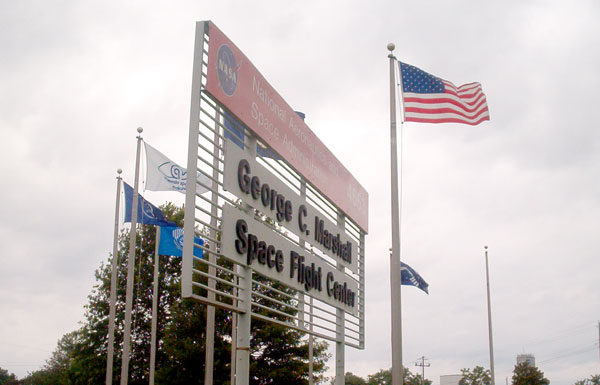
That pole is reserved for the flags of the Orbiters. Each Orbiter in the Shuttle fleet has its own flag (Discovery's is visible in this photo), and that flagpole is used to fly those flags when the Orbiter is in flight. With no Shuttle missions since Feb. 2003, the flagpole has been empty.
Tomorrow, however, that should change.
Taking A Napster
 Per eCommerce Times:
College students at one of the universities partnered with Napster for free access to its subscription-style music offering give the service high marks, but more than seven out of every 10 still buy music from Apple's market-leading iTunes Music Store.
Monday, 11 July 2005
On Writing
I'm posting this mostly for Richie's benefit, but I cut out a comic strip from yesterday's paper to hang up in my cubicle, and it was Peanuts.
ATW Soundrack
Go head´ on and break em off wit a lil´ preview of the remix....
If you're reading this blog, then, by definition, you're cooler than the average public.
But, with all due respect, statistically speaking, chances are I'm still cooler than you.
Why? Well, if not for my own merits, then by the overwhelming coolness of my associates.
As just the latest example, this blog now has its own official theme song: All These Worlds (Tiny, Tiny Kitties remix)
This brilliant bit of work is the creation of none other than GarageBand master Joe Gurner (who also provided a theme for The Leonardo Code. For more great Joe stuff, check out the Mac Idol page for New Orchestral Seagulls in the Mode.
So, yeah, you probably don't even have a theme song.
And I've got a remix!
4411
So this blog has been a big fan of The 4400 since its debut (initially, to be sure, for its connection to the greatest series in television history, Deep Space Nine), but lately has growing concern about the series.I really enjoyed the anthology nature of the original miniseries, with each episode focusing on the story of a different 4400; basically a completely non-comic book superhero show, and a format that could stay strong for, well, 4400 episodes.
Lately, though, the series has been focusing increasingly on the mythology (I think last night's episode may have been the first not to introduce a new 4400). I like the mythology stuff -- though not as much as the anthology stuff -- but it worries me any time a series focuses too much on that. While the anthology format could literally run for like 150 seasons, a good mythology run (like Babylon 5 almost had) really needs to have a good wrapping up point.
I'm still really digging on the series, but am a bit more guardedly optimistic about the future.
Today In History
 Buy this image at Barewalls.com
On this date in 1979, the Skylab space station reentered Earth's atmosphere more than six years after its launch, breaking up over the Indian Ocean and western Australia.
RTF Update
The official countdown clock is still underway and now reads only one day and three hours until launch (because of the built-in holds it includes.)While everyone is looking ahead two days to the launch, The St. Petersburg Times has an article looking back 17 years to 1988's STS-26 Return to Flight mission; a very interesting story about the first post-Challenger mission.
Reading it, though, I was reminded about how Wednesday will be different from Sept. 29, 1988 -- STS-26's was successful less than a minute and a half after launch, when it made it past the point at which Challenger had been lost.
While Wednesday's launch will be a huge, huge thing, NASA won't really be able to breathe again until Discovery has all wheels safely on the ground.
The Huntsville Times has an article about the important role Marshall has played in making the Shuttle safer in preparation for RTF. Gotta include that as a shout-out to my homies!
And if anybody's interested in what STS-114 will be doing besides launching and landing, The Orlando Sentinel has a summary of the mission.
From the "New Beginnings" file: collectSPACE notes that the Solid Rocket Boosters used on the STS-114 mission include one segment that flew on the very first Shuttle flight, STS-1, over 24 years ago. (Which means that a small part of Columbia's first launch will be a part of returning the fleet to flight after her loss.)
Used tags: collectspace, history, launch_schedule, nasa, rtf, space, space_shuttle, sts_114, sts_26
The Future Nears
While, since taking office, new NASA administrator Mike Griffin has been outspoken about the need to get more done by the time the Shuttle fleet is retired in 2010, I have seen very little he's said about the future after 2010. Apparently, that will soon change -- Griffin is expected to soon reveal details of his plan to impliment the Vision for Space Exploration.
Sunday, 10 July 2005
Another Movie Review
Let anyone think from recent postings that all I ever watch is summer sci-fi flicks, Nicole and I went and watched Mad Hot Ballroom tonight.
Not bad, but I was somewhat disappointed. Nicole, I believe, enjoyed it a bit more than I, in that she appreciated it more at face value -- the story of kids in NYC schools that had to take a ballroom dancing class and then went to competition; showing them learning to dance, and then doing so.
But we both would have liked a bit more big picture background. The movie talked about the fact that a lot of the students involved were disadvantaged, and then at the end quotes some people as saying it made a difference for some of the kids. We both would have liked to have seen more of that -- the context in which the program takes place, and how it affected the students involved.
In the future, I demand more gravitas in my ballroom-dancing middle-schooler flicks!
RTF Update
The countdown is officially underway.Launch officials estimate a 30 percent chance of a weather-related scrub Wednesday.
Saturday, 9 July 2005
RTF Update
Per SpaceRef.com:Due to the expected arrival of Hurricane Dennis in the Gulf Coast, the crew of STS-114 will now arrive at KSC a day early. Their new target arrival time is at 6:30 p.m. Saturday, July 9, at the KSC Shuttle Landing Facility. Media need to be flexible because this time may be delayed due to the uncertainty of the weather.
I'm posting this at least half just 'cause I'm really digging on posting the constant RTF Updates at this point, and looking forward to not posting them anymore.
Do You Reed?
Eh, so watched the Fantastic Four last night.
Decent job of capturing the spirit of Fantastic Four, but most of the people who care about that would probably be alienated by the nonstickler interpretation.
Not much of a movie, though.
Friday, 8 July 2005
Favor Request
I've got a favor I would appreciate if the ATW Community could help me with. The awesome collectSPACE Web site that I talk about on here from time to time has been nominated as one of the best Houston-based blogs. Now that it's been nominated, The Houston Chronicle is letting people vote online to determine who will be the winner. It would be great to see cS win this, and I would really appreciate it if my readers would go vote for collectSPACE in the contest.
(I looked through some of the other contests, and a lot of them mean nothing to me, but, hey, where else can non-Texans get a chance to vote for [or against] Tom DeLay? And you know you're in Texas when you have a category for "Place To Buy Cowboy Boots.")
Used tags: blog, collectspace
Heading To The Cape
 Though the old DM crowd will likely recognize the name from the band's frequent appearances in Oxford, I can't say that I've heard much about Big Head Todd & The Monsters in a decade or so. According to liveDaily, though, the group has written a new song that has become the Return-to-Flight theme song and will be on hand for the launch.
The song, "Blue Sky," will be available exclusively on iTMS starting Tuesday.
Set For Stun
 From SpaceDaily:
The Department of Energy is turning to old Star Trek phasers to protect its 103 civilian nuclear plants.
Energy weapons capable of harmlessly stunning intruders are being developed and should be in general use by 2008. But many experts warn they will be inadequate and unnecessary for the real security dangers nuclear plant guards would face.
RTF Update
In a midnight meeting last night, it was decided that Hurricane Dennis does not pose enough of a threat to merit rolling Discovery back from the pad and scrapping the July 13 launch date.T -5 days, 6 hours, 17 minutes.
And still counting!
Addendum: Technically, the official countdown will begin Sunday.
Confession
 All right, here's a rather prurient admission for this normally family-friendly blog (so if you're not the sort of person for reading such things, stop here): In borderline cases, I always like to err towards assuming Arlo & Janis is being dirty.
Thursday, 7 July 2005
If You Believe...
This week's new Hatbag strip is dedicated to Bill Kaysing.
Reporter Jailed
 Per The AP:
WASHINGTON - Will the jailing of New York Times reporter Judy Miller scare people off from risking careers to tell reporters about government misdeeds? Or will Miller's willingness to sit behind bars rather than name a confidential source embolden such whistleblowers?
As Miller was led from court to a jail cell Wednesday, news executives and observers debated those questions. Saddened by Miller's fate, most feared sources will be less likely to talk; some hoped they will be reassured.
On the government side, U.S. District Judge Thomas Hogan, who sent Miller to jail for almost four months unless she recants and testifies, and prosecutor Patrick Fitzgerald, who demanded her jailing, took pains in court to say they were not trying to deny reporters their sources.
RTF Update
During the night, Hurricane Dennis continued to the west, moving Kennedy Space Center out of its apparent likely paths.T -6 Days, 5 Hours, 18 minutes. And counting.
GO To Orbit Again Update
 Itar-Tass is reporting that Roskosmos has announced that Greg Olson will become the third space tourist to visit the International Space Station on October's Soyuz launch.
Son Of Tucson?
 Watching the very end of Return of the Jedi again last night, it got me wondering about the line that's shouted in the celebration scenes at the end of both the Jedi Special Edition and The Phanom Menace, something along the lines of "son of two suns."
Surprisingly, a Google search for that term produces only one result, and the only reference to it on that page is the line, with a link, Journal of the Whills, 3:127, on it that turns out to be a dead location on TheForce.net.
Am I mishearing the line? It seems unlikely that there would be a reference like that in Star Wars that would only be mentioned once on the entire Web.
Curious.
Wednesday, 6 July 2005
RTF Update
In announcing the official launch date after the FRR last week, NASA officials said the biggest concern that could stop STS-114 from taking off on July 13 was weather. Now, one week before the launch, NASA is keeping an eye on Tropical Storm Dennis. While the storm is currently expected to move away from the Cape, the possibility that it could cause damaging winds at KSC could lead to the Shuttle being moved off the pad, and the launch delayed.
Looking Back
 As the world looks ahead to next week's launch of the Space Shuttle Discovery, the AP's Marcia Dunn looks back to the disastrous last Space Shuttle mission, with a profile of four men tied to the loss of Columbia.
Kirk Here
 OK, I totally want one of these!
The Other Countdown
For those that haven't heard, with just under 483 million songs downloaded so far from the iTunes Music Store, Apple has started a contest to countdown to the half-billionth song song sold on iTMS. Prizes will be awarded at 100,000 song intervals, and the grand prize winner will pick up 10 iPods of his or her choice.
Tuesday, 5 July 2005
Leonardo Code Note
 Browsing the internet over the weekend, I came across Cafepress' on-demand printing service, which could, hypothetically, be used to print up some copies of The Leonardo Code when it's finished, if there were interest.
Progress In Publishing
 After hearing rumors that this would likely be coming toward the end of the month, I got confirmation today that three Mississippi newspapers I was once associated with, The Webster Progress-Times, The Choctaw Plaindealer and The Winston County Journal, have been purchased by Emmerich Newspapers, Inc., from Boone Newspapers.
"These are great weekly newspapers that serve an important role in their communities," Wyatt Emmerich, president of Emmerich Newspapers said. "Our goal is to make them the best possible newspapers that their market can support. My company specializes in community newspapers, and we think we do a good job in serving the communities."(more)
Regular Richie Feature
 Search strings for Hatbag.net for the first few days of July:
- science humor funny
- "funny picture"
- alan rickman dogma
- transformers live action movie
- Bush Stupid
- In A Mirror Darklyenterprise
- Recent ISS Photos
- drunk flash
- frat guy
- george w bush drunk
- popeye's naked chicken
- skylab "july 11"
- return of the jedi anakin ghost
Still several variations of that last one, but not as bad as last month.
SDLV Times Two

 The concepts aren't really new, but NASA Watch is reporting than it's now official that NASA plans to use Shuttle-derived launch vehicles to support the Vision for Space Exploration.
A heavy lift vehicle for cargo would be created by placing a second stage and payload shroud vertically atop an ET/SRB stack, while a crewed spacecraft launch vehicle would be created by adding a second liquid stage on top of a five-segment SRB.
Among the advantages would be a potentially shorter curve in humanrating the vehicles and the ability to use a large amount of existing infrastructure.
The plan would still have to win approval from the powers-that-be in Washington.
RTF Update
As NASA works down here to get the Shuttle ready for its Return to Flight launch next week, preparations are also taking place in space, as the Expedition 11 crew of the International Space Station prepare for the ISS's first visitors since December 2002.On another RTF-related note, I fixed the countdown in the sidebar over the weekend so its correct in places other than the Central time zone, and now reflects the accurate launch time down to the second.
Monday, 4 July 2005
...And The Rockets' Red Glare...

Here's wishing you and yours a happy Fourth of July!
Have A Hatbag Fourth!
Hatbag is celebrating the occasion with some patriotic Hatbag art and holiday wishes for you and yours.
Impact Of Deep Impact

Per NASA JPL:
After 172 days and 431 million kilometers (268 million miles) of deep space stalking, Deep Impact successfully reached out and touched comet Tempel 1. The collision between the coffee table-sized impactor and city-sized comet occurred at 1:52 a.m. EDT.
"What a way to kick off America's Independence Day," said Deep Impact Project Manager Rick Grammier of NASA's Jet Propulsion Laboratory, Pasadena, Calif. "The challenges of this mission and teamwork that went into making it a success, should make all of us very proud."
"This mission is truly a smashing success," said Andy Dantzler, director of NASA's Solar System Division. "Tomorrow and in the days ahead we will know a lot more about the origins of our solar system."
Sunday, 3 July 2005
Buy Hatbag & Save
 Hatbag t-shirts are now on sale!
Friday, 1 July 2005
Blogpoint Opportunity
OK, at long last, I'm wrapping up the Blogpoint Contest that my laziness caused to drag through three months. The winner of the April-May-June Blogpoint contest was Lain, with 336 points.The rest of the results were as follows:
Joe -- 160 Blogpoints
Mrs. Tutor -- 81 Blogpoints
Jordan -- 62 Blogpoints
Tutor -- 51 Blogpoints
Willer Lite -- 15 Blogpoints
Richie -- 9 Blogpoints
Deedee -- 8 Blogpoints
I'm going to do better this month, and, as a show of faith, I'm starting the month off with a new Blogpoint contest, one of those guess the song lyric deals. I'm going to list lyrics from songs largely randomly chosen by my iPod. Blogpoints will be awarded to whoever can identify the songs. The first person to post will get 2 Blogpoints per song, the second person 3, etc., with the idea that the earlier responders will be getting the easier songs. Oh, and no fair using a search engine.
On a side note, let me issue a reminder that the next Leonardo Code update is worth 50 Blogpoints. (more)
Apropos Comics
(Link added to the sidebar)
Deep Thoughts
 I'll be doing the family thing Sunday and Monday for Independence Day, so I can't promise you'll get another Deep Impact reminder after this. This Space.com article has information on watching the event. (Most notably, NASA TV -- also available online -- will cover the impact.)
To The Moon!
 Believe it or not, I've never seen HBO's From The Earth To The Moon series, and so I'd kind of like to get the new signature edition coming out on Sept. 20, though it's a bit pricey for my DVD-buying tastes.
Also, I think I liked the old packaging better.
Gave War A Chance
 In the event that aliens invade the Earth, particularly assuming they begin by wreaking destruction with giant war machines, I hereby declare Sunflower, Miss. to be the official ATW meeting place. Where ever you are, whatever you're doing, when the attack begins, drop what you're doing, and go to Sunflower (Hwy. 49 E, about 7 miles north of Hwy. 82), and we'll rendezvous there and figure out what to do.
So we went and watched War of the Worlds last night, and it was one of the best movies about Tom Cruise running and sometimes hiding ever. Spielberg and Cruise had begun to tap the potential here with their previous pairing on Minority Report, but the Cruise running and sometimes hiding in that movie was diluted by Tom Cruise talking and sometimes doing things. This movie also plays much better to Spielberg's strength -- scenes of people looking. In fact, this movie may contain the best Spielbergian people-looking scenes since the Jurassic Park movies.
It wasn't really bad, per se, it just, in my opinion, failed to live up to its potential. Certainly not the best I've seen this summer. Kudos for the ending, though.
On a side note, there's a chance I might be more interested in The Island if it weren't just an obvious rip-off of Parts: The Clonus Horror.
Sunday, 31 July 2005
Sunday Blogging
(Read Entry)
One More Day
(Read Entry)Saturday, 30 July 2005
Eight, Nine Or Ten?
(Read Entry)
A Future Yet
(Read Entry)Friday, 29 July 2005
That Our Flag Was Still There...
(Read Entry)
Editorial Note
(Read Entry)
Happy Anniversary!
(Read Entry)Thursday, 28 July 2005
Godspeed, Discovery!
(Read Entry)
The Sleeper Awakens!
(Read Entry)
The Future
(Read Entry)
Virgin Honeymoon
(Read Entry)
Together At Last!
(Read Entry)
Videopod Update
(Read Entry)
iPhone Update
(Read Entry)
Grounded
(Read Entry)Wednesday, 27 July 2005
Watching Through Windows
(Read Entry)
Russian Around
(Read Entry)
Debris Events
(Read Entry)
Parsons Profile
(Read Entry)Tuesday, 26 July 2005
Go!
(Read Entry)
Very Last RTF Update
(Read Entry)
Apple-Free World
(Read Entry)
iPhone Update
(Read Entry)
RTF Update
(Read Entry)Monday, 25 July 2005
RTF Update
(Read Entry)
In The House
(Read Entry)
iPhone Update
(Read Entry)Sunday, 24 July 2005
Downs Of Up
(Read Entry)Saturday, 23 July 2005
Jam Time
(Read Entry)
Taking It To 11
(Read Entry)Friday, 22 July 2005
RTF Update
(Read Entry)
Peer Review
(Read Entry)Thursday, 21 July 2005
Seth's Discovery
(Read Entry)
CheckMac
(Read Entry)
Nemesis CE DVD
(Read Entry)
Last Flight
(Read Entry)
Silver Apple
(Read Entry)
RTF Update
(Read Entry)Wednesday, 20 July 2005
The Miracle Worker
(Read Entry)
Videopod?
(Read Entry)
Today In History
(Read Entry)
RTF Update
(Read Entry)
The Next Step
(Read Entry)Tuesday, 19 July 2005
We're Back
(Read Entry)Saturday, 16 July 2005
Happy Saturday
(Read Entry)Friday, 15 July 2005
RTF Update
(Read Entry)
Today In History
(Read Entry)Thursday, 14 July 2005
What's Love Got To Do With It
(Read Entry)
RTF Update
(Read Entry)
Early Retirement?
(Read Entry)
Triple Sunset
(Read Entry)
44112
(Read Entry)Wednesday, 13 July 2005
RTF Update
(Read Entry)
Casting A Net
(Read Entry)
RTF Update
(Read Entry)
Blogcasting
(Read Entry)
Blogpoint Opportunity
(Read Entry)
Dude, I'm Chunking A Dell!
(Read Entry)
Today In History
(Read Entry)Tuesday, 12 July 2005
Looking Back
(Read Entry)
Countdown Explained
(Read Entry)
RTF Update
(Read Entry)
Today In History
(Read Entry)
The Empty Flagpole
(Read Entry)
Taking A Napster
(Read Entry)Monday, 11 July 2005
On Writing
(Read Entry)
ATW Soundrack
(Read Entry)
4411
(Read Entry)
Today In History
(Read Entry)
RTF Update
Looking back on last Return to Flight. (Read Entry)
The Future Nears
(Read Entry)Sunday, 10 July 2005
Another Movie Review
(Read Entry)
RTF Update
(Read Entry)Saturday, 9 July 2005
RTF Update
(Read Entry)
Do You Reed?
(Read Entry)Friday, 8 July 2005
Favor Request
Help cS be named best Houston-area blog. (Read Entry)
Heading To The Cape
(Read Entry)
Set For Stun
(Read Entry)
RTF Update
(Read Entry)
Confession
(Read Entry)Thursday, 7 July 2005
If You Believe...
(Read Entry)
Reporter Jailed
(Read Entry)
RTF Update
(Read Entry)
GO To Orbit Again Update
(Read Entry)
Son Of Tucson?
(Read Entry)Wednesday, 6 July 2005
RTF Update
(Read Entry)
Looking Back
(Read Entry)
Kirk Here
(Read Entry)
The Other Countdown
(Read Entry)Tuesday, 5 July 2005
Leonardo Code Note
(Read Entry)
Progress In Publishing
(Read Entry)
Regular Richie Feature
(Read Entry)
SDLV Times Two
(Read Entry)
RTF Update
(Read Entry)Monday, 4 July 2005
...And The Rockets' Red Glare...
(Read Entry)
Have A Hatbag Fourth!
(Read Entry)
Impact Of Deep Impact
(Read Entry)Sunday, 3 July 2005
Buy Hatbag & Save
(Read Entry)Friday, 1 July 2005
Blogpoint Opportunity
(Read Entry)
Apropos Comics
(Read Entry)
Deep Thoughts
(Read Entry)
To The Moon!
(Read Entry)