+ 1 - 0 | §¶New Spaceflight Record (For A Little While, Anyway)
Per NASA: "Today Lopez-Alegria sets a U.S. record for a single flight of 196 days in space." His crewmate Suni Williams will break that record before her return to Earth, however.
Disclaimer
The opinions expressed on this page are those of the author, and very likely no one else.
Joe (STS-117 Update): They aren’t running Vista… Lain (STS-117 Update): So, how worried should we… David (Puddles On Mars): So, about those puddles? … David (Forward The Futur…): Now here’s hoping the fun… David (STS-117 Update): Oh, very nice! I’m jealou… Nancy (Forward The Futur…): Well, it seems like NASA… shirley (STS-117 Update): early sunday watched both… David (World's Largest T…): Yeah, I’ve gotten a bette… Joe (World's Largest T…): It’s the robots that are … David (World's Largest T…): Nah, that would be just t…
Per The Daily Mississippian: Two Ole Miss engineering majors will be spending their summer in Huntsville, Ala., interning at the Marshall Space Flight Center through NASA.
Sophomore mechanical engineering major Bob Aune and sophomore chemical engineering major Christin Burns are two out of four students from Mississippi that will be part of the program this summer.
Burns interned for NASA last summer, working on a project that involved testing adhesives used to repair tiles on a space shuttle while in orbit.
I have no idea whether the Russian Space Agency, Roskosmos, has an official motto or not, but, if it were needing one, it could certainly do worse than Jerry Maguire's "Show me the money."
Every year, there are multiple announcements from RSA saying, "Oh, we could totally do _________," with a caveat that they're just waiting for someone to pay for it. They could build a new, larger spacecraft, if ESA or someone would partner with them. They could fly more Soyuz capsules to ISS, if someone were willing to pay for them. Etc.
One of the more interesting ones a while back was that they could send Soyuz vehicles on circumlunar flights. If, naturally, tourists wanted to pay for the trip. An interesting idea, but I haven't heard anything else come of it.
Per Space.com: A privately-built rocket blasted off from New Mexico's Spaceport America Saturday, roaring skyward to the edge of space carrying a variety of payloads - including the ashes of Star Trek's "Scotty" James Doohan and NASA Mercury astronaut Gordon Cooper.
A SpaceLoft XL rocket shot upwards on a suborbital trajectory, launched by UP Aerospace, a Connecticut-based company. The mission - labeled SL-2 - was loaded with an array of educational investigations, as well as commercial and entrepreneurial payloads.
Per the European Space Agency: If you think you can come up with the ideal playlist for astronauts flying around the Earth in the International Space Station , ESA wants to hear from you.
...
ESA is launching a competition to find a set of 10 tunes that is out of this world. All you have to do is write down a song selection that you think would be most suitable for the astronauts on the ISS to listen to. Before you decide, try to put yourself in the shoes of the men and women who live on the Station and put together a playlist that would cheer them up, inspire them, etc….
...
The winner’s playlist will be downloaded onto an iPod and sent to the ISS in ESA’s Automated Transfer Vehicle (ATV), which will be making its maiden flight later this year. The 20 tonne craft, named ‘Jules Verne’, after the famous French science fiction writer, will be delivering about seven tonnes of cargo to the astronauts living in the International Space Station.
The bad news, though: "Entries are only accepted from nationals of the following countries which are participating in the ATV programme: Belgium, Denmark, France, Germany, Italy, Netherlands, Norway, Spain, Sweden, Switzerland."
I've been playing some more with the possible redesign of ATW, which, at the moment, I'm really inclined to implement. I haven't made many purely aesthetic changes since I last wrote about it, though I've made a few minor aeshetic/functionality tweaks that you may or may not notice. I've also played with the Tags feature (which show up on the old-school ATW as keywords, without the cool things they do in the Sandbox), and have improved, among other things, the search feature.
Partially in response to the criticism that fewer items are visible at a time in the redesign, I've also created an ATW Headlines version of the blog, where you can rapidly scroll through the brief descriptions of the entries.
Like I said, I'm planning now to switch to the redesign version of ATW when I'm finally happy with it (It's now the version of the blog I use most of the time). In the meantime, I'd really appreciate any feedback. If there are things you like about the current design that changed in the redesign, let me know, and it may be possible to combine elements between the two.
Also, the Sandbox version is still only the full version of the blog, but, for readers of the Space blog, if I redesign the full blog, I'll probably redesign the Space version in a similar manner. (Based on some ideas I have for the third ATW blog, though, I may start playing with individual distinctive looks for the different versions, but that's further down the road.)
I know you're rightfully proud of creating a robot duplicate of yourself, that looks and moves exactly like you. It's quite a scientific accomplishment.
But remember: Creating humaniform androids may seem like all fun and games, until someone starts the robot holocaust.
OK, yeah, I'm enough of a SciFi geek that the idea of a Class M planet (or "Minshara Class") resonates with me: "They are always located in the ecological region of a star where they are provided enough warmth and energy to develop and sustain carbon-based life," says Wikipedia. "Their surfaces comprises a thin tectonic layer floating on a molten rock mantle and they usually have many active volcanoes. Most importantly, they have plenty of liquid water necessary for life to exist. Their atmospheres contain oxygen and nitrogen with other trace gases."
In other words, planets kind of like ours.
It's too soon to say for sure that Gliese 581 c is a Class M planet, but, for the first time, astronomers have found an extrasolar world they believe could very possibly fit the classificiation.
The planet is in the Goldilocks Zone for liquid water around a red dwarf, not that far away -- a mere 20.5 lightyears.
Life on Gliese 581 c would be a bit different -- while the planet's circumfrence is only half again that of Earth, it's density is such that humans would have to adjust to a constant 5-g's; and a year there lasts only 13 days.
Although astronomers believe water could exist on the planet, they have no idea yet whether it actually does or not. And, even if it does, habitability could be limited. Some astronomers believe that, because of its proximity to its star, Gliese 581 c may be gravitationally locked to its star as the moon is to the Earth, so that one side is always facing it, creating a huge variation in heat from one side to the other. (The article doesn't say this, but it would seem, depending on what effect that had on an atmosphere, there would still be the possibility of a temperate zone at the terminator.)
Regardless of what the exact conditions on Gliese 581 c may be, the important thing is this -- these worlds do exist. It's just a matter of finding them.
Per Information Week: The National Aeronautics and Space Administration is the latest federal agency to put a hold on PC upgrades to Windows Vista. NASA has decided against deploying Microsoft's five-month-old operating system anytime this year.
The decision puts NASA in company with the Federal Aviation Administration and the U.S. Department of Transportation, both of which in February revealed temporary bans on Vista.
...
In a meeting with IT professionals and user-group representatives last week on Microsoft's campus, CEO Steve Ballmer rejected an assertion by a NASA computer scientist that Vista has been banned by most sectors of the federal government.
"Vista has been anything but banned from most parts of the U.S. federal government," Ballmer said, adding that he anticipated near-term adoption in "a number" of government accounts. He stopped short, however, of naming any government agencies that are in the process of deploying Vista or about to do so.
In the meantime, though, I thought I'd pass along this recent review of the book, which does a pretty fair job of describing what's in the book, even if it fails to really capture what makes this book special.
New wide-angle panorama of the Carina Nebula, one of the largest Hubble panoramas ever. NASA et al, via Cosmic Log.
On this date in 1990, the Hubble Space Telescope was launched aboard the STS-31 mission of Space Shuttle Discovery. The telescope was deployed the next day. Problems with its mirror would be corrected more than three years later on the STS-61 mission. Preparations are currently underway for a final Hubble servicing mission in September 2008.
Also on this date, in 1962, a television picture was transmitted through space for the first time via the Echo 1 satellite, and, in 1967, Vladimir Komarov became the first person to die during an orbital spaceflight when the parachute during the reentry of his Soyuz 1 capsule.
And, if for some reason, you don't have a pair of 3-D glasses handy, there are some good 2-D pics there as well.
Per NASA: STEREO (Solar TErrestrial RElations Observatory), ... launched October 2006, will provide a unique and revolutionary view of the Sun-Earth System. The two nearly identical observatories - one ahead of Earth in its orbit, the other trailing behind - will ... will reveal the 3D structure of coronal mass ejections; violent eruptions of matter from the sun that can disrupt satellites and power grids, and help us understand why they happen. STEREO will become a key addition to the fleet of space weather detection satellites by providing more accurate alerts for the arrival time of Earth-directed solar ejections with its unique side-viewing perspective.
Several people from ATW-fave fields are included in the list, including U2 frontman Bono, iCEO Steve Jobs, Apple Chief Designer Jonathan Ive, Wikipedia founder (and Huntsville native) Jimmy Wales, noted Frank Miller parodyist Frank Miller, Virgin Galactic's Richard Branson and astrophyscist Neil Degrasse Tyson (and possibly some others, the interface was annoying, so I may have missed someone).
I don't usually post about other things I'm working on here, but we recently had a project go online at work that I'm rather pleased with.
As part of our team's support for the upcoming STS-118 flight of Educator Astronaut Barbara Morgan, our other writer and I traveled out to Johnson Space Center a while back to conduct interviews with a small handful of the many, many people on the ground that are involved in making the STS-118 mission happen.
The series of features tells the story of the STS-118 mission in a way that you would not normally hear it, and showcases for students and teachers some of the wide variety of jobs that make up the NASA workforce.
The people we talked to were really fascinating, and had some interesting stories.
Yeah, it had its flaws, but it had good heart, and I liked its accessible space-positive attitude. Given its disappointing theatrical run, I was all for it having a decent second life on DVD.
But $28 bucks for a version with no special features besides the trailer? Nah, I'll pass.
This was a movie that cried out for some good extras, like what went into making its well-researched Mercury-Atlas recreation. I'm sure there would have been some AltSpace types that would have been glad to talk about the real-world private rocket builders. But, alas, it's apparently not to be.
I've been doing this whole blog thing for a while now, and consider myself fairly blog-savvy, but every once and a while I come across something I'm just completely clueless about.
For example, until today, I was completely oblivious to the idea of "blog carnivals."
As I understand it, a blog carnival is a sort of regular round-up of related posts on a variety of blogs. I was introduced to the concept by the Why Homeschool blog, which is working to set up a Carnival of Space.
Again, this is just my undestanding, but apparently the CoS will be a place where multiple blogs can submit space-themed posts into a weekly digest. Readers can then go to the Carnival and skim though space content from multiple blogs in one place.
So for any other space bloggers out there, go check it out, and for ATW readers, it's sounds like it'll be a great tool for reading a variety of good space content.
I'll almost certainly be submitting stuff before long, but a) I want to see an edition or two (the first one hits April 26) to make sure I've got the idea right, and b) I'll have to write something worth sharing.
I've been meaning to post this for a while, but had to wait until I could find it online.
When I started reading this article, it sounded like the most exciting scientific development I'd come across in quite a while. Further into it, it more or less specifically says that it doesn't mean the cool things I thought it did in the beginning, but, even so.
Basically, some researchers have found a way to store human memories to computer chips. Plug the chip into your brain, and if functions like a second hard drive supporting the old biochemical method.
The obvious benefit is that said method would be immune to the thousand natural shocks that flesh is heir to. Fear Alzheimer's is setting in? Just upgrade your old storage to the latest hardware.
But -- while the article says this isn't feasible, one can't help but suspect that, if this were to be widely adopted, it would open the door for unbelievable breakthroughs.
The biochemical processes that allow us to store and recover information are pretty opaque to science at the moment; at least in terms of decoding how the information is written.
But electronic data storage? Yeah, that's a whole lot more mature.
Granted, the brain wouldn't write to the chip using the same protocols as a computer, and, as the article points out, its protocols are going to be far more difficult to figure out.
Ultimately, however, it is just an electronic data storage protocol, and I have a hard time believing that the incredible wealth avaliable to anyone who figures out how to crack the code won't provide enough incentive for someone to do it. Maybe not immediately, but eventually and inevitably.
Figure out how to write specific memories to the chip, and how to copy that data, and bingo -- We can remember it for you wholesale.
Figure out how to write data onto the chip, and with a quick download, you can know kung fu.
The first 3-man crew arrived a few days later after being launched by the workhorse Soyuz booster (shown below). But, something stuck and they couldn't get it, requiring them to return to Earth. The second crew, with tools to open th Salyut, did enter and stayed for 16 days. But, tragically, upon return, a leak in their spacecraft sucked out all oxygen, so that they died enroute.
The Russians were developing another spacecraft to be used for military observations. This Almaz series was a response to the U.S. Air Force's plans for manned observatories. The first Almaz was "disguised" as Salyut-2 to prevent other nations from awareness of the "spy" effort. This Salyut-2 was launched on April 3, 1973 but was never visited because a fire broke out onboard, so damaging the ship that it was uninhabitable and was decelerated into the atmosphere on May 28, 1973.
Because of these problems, when a space station was finally manned by multiple crews in 1973, it was not a Soviet facility, but rather the American Skylab.
OK, I've managed to avoid playing with my blog template for quite a while now, particularly when it comes to making layout changes.
But... I've been helping someone with some design work for another site (well, really just coding work -- he's making the design decisions, I'm just helping to implement them), and there have been some things to come out of that work that I've really liked, and it made me wonder what ATW would be like if I made some changes.
Anyway, I've started drafting a new design for ATW, and I'd appreciate any feedback on it. It still needs some tweaking, but I've reached the point with it where there's no point putting a lot more time into it just to throw it away. (If you're reading this on the space blog, you'll note that the redesign shows the full blog, but, if I end up making a change, I have the option of using the same design for the space blog, or not, if that's what people think.)
I would appreciate any comments, but for those who aren't the type to actually post comments, I have a handy one-click feedback poll here:
From Spaceflight Now: NASA managers are reassessing whether to leave astronaut Sunita Williams aboard the international space station until August, a longer-than-planned stay because of a shuttle launch delay, or to bring her home aboard the Atlantis when flights resume in June, sources say.
Williams was launched to the station aboard the shuttle Discovery in December. She originally planned to return to Earth aboard the shuttle Endeavour in June, after the flight of Atlantis in March. But Atlantis was grounded by hail damage to the ship's external tank and the March launch has been delayed to no earlier than June 8. As a result, Endeavour's launch has slipped to Aug. 9 and along with it, Williams' ride home.
Bill Gerstenmaier, NASA's chief of spaceflight operations, said during a news conference April 10 that barring major problems, Williams would come home in August aboard Endeavour as planned. He said the impact of additional exposure to space radiation was minimal.
Sources, however, now say NASA is revisiting the issue but a timetable for making a final decision was not known.
For her part, Williams said during an earlier interview she was not overly concerned about increased exposure to space radiation or any other aspects of a longer-than-planned stay in space.
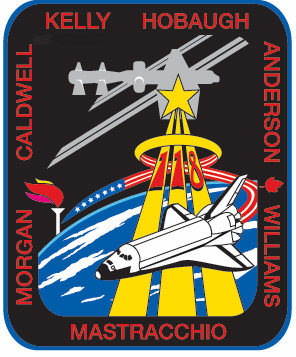
I've updated the left-hand sidebar with the latest changes to the space shuttle launch schedule. STS-117, currently scheduled for June 8, remains the same; STS-118 moves back four days to August 9; and the next four flights get new working target dates.
I've not heard anything about how this affects the schedule after STS-124, but since the next mission, STS-119, was not scheduled until July 2008 anyway, the slip from February to April on STS-124 could theoretically still allow for making the July date for 119 and picking up the previous schedule from there. But, of course, I'll update as new announcements are made.
If you have one in your area, you can celebrate the occassion at a Yuri's Night party (and, if you don't, you can go online for the Second Life party). I'll be missing out, I'm afraid -- despite the fact that Huntsville is listed as a party site, I've seen no information about an event, and the organizer didn't respond to e-mail. And I'm not doing the Second Life thing. I can barely handle the one.
OK, this week, not only do we have the regularly scheduled new Hatbag strip, we also have bonus strips! Not one, not two, but -- oh, wait, no, two. Anyway, enjoy.
We're still trying to make some progress in the top comic list polls again, so please feel more then free to vote Hatbag.
And, since apparently a bunch of ATW readers don't follow the weekly Hatbag link, I thought a brief explanation might be in order -- Hatbag is a weekly webcomic Lain and I create; following two old college buddies as they adjust to sort-of grown-up life. If you read ATW, take a few extra seconds to go read Hatbag. Please? Please?
As reported by the Associated Press, Yurchikhin told journalists: “So the next time someone will be with Bill Gates. For me this is the biggest surprise of our flight.”
Which, of course, I have mixed feelings about. What I would love to see, though, is a combination of this piece of news, the old rumors that Russia was considering flying tourism-dedicated Soyuz flights with one cosmonaut and two spaceflight participants, and the announcement that Gates and Steve Jobs were going to be sharing the stage at the upcoming D5 conference -- How could would it be to see the wacky adventures of Bill and Steve in space‽
Per Space.com: Astronomers have detected water in the atmosphere of a planet outside our solar system for the first time.
The finding, to be detailed in an upcoming issue of Astrophysical Journal, confirms previous theories that say water vapor should be present in the atmospheres of nearly all the known extrasolar planets. Even hot Jupiters, gaseous planets that orbit closer to their stars than Mercury to our Sun, are thought to have water.
The discovery, announced today, means one of the most crucial elements for life as we know it can exist around planets orbiting other stars.
“We know that water vapor exists in the atmospheres of one extrasolar planet and there is good reason to believe that other extrasolar planets contain water vapor,” said Travis Barman, an astronomer at the Lowell Observatory in Arizona who made the discovery.
HD209458b is a world well-known among planet hunters. In 1999, it became the first planet to be directly observed around a normal star outside our solar system and, a few years later, was the first exoplanet confirmed to have oxygen and carbon in its atmosphere.
You'll notice that the countdown clock in the upper left has finally been reset. There's now a launch date for STS-117 again: June 8. NASA announced yesterday that it was going to proceed with repairing the hail-damaged external tank, with an eye towards rolling the vehicle back out to the pad around May 6.
The move will push the next flight, STS-118, from June 28 to NET August 5. Shuttle manager Wayne Hale said he hopes to be able to fly two missions after that in October and December, which would put the program at the end of the year one flight behind where it was scheduled to be before the hailstorm.
And, as of this writing, we're at T -58 days, 9 hours, 22 minutes.
Initially I was just going to drop this story about George Takei visiting Kennedy Space Center to talk about diversity in the sidebar link section, but that would have meant that I wouldn't have been able to use the picture that's with this post, which I like. So now I've written a post about it that says basically nothing other than the fact that I've written a post about it. But it does have a picture.
NASA officials are meeting today to evaluate the progress of repairs to the hail-damaged ET-124, and will be deciding whether to proceed with those repairs and use that external tank for the STS-117 mission, or whether to replace that tank with a new one, which could delay the mission further. An announcement is expected today, no earlier than 5 p.m. CDT.
Per Aviation Week and Space Technology: The Bigelow Aerospace commercial inflatable manned space module venture intends to have three large multi-module outposts in Earth orbit by 2015 to serve different user communities.
CEO Robert T. Bigelow says his engineers predict 800 paying crewmembers could fly to Bigelow outposts over the next 10 years.
...
As many as 12-14 commercial launch vehicles could fly cargo and crew to the first outpost in its initial year of manned operations as early as 2012, says Eric Haakonstad, Bigelow Genesis module program manager.
...
The NASA Commercial Orbital Transportation Services (COTS) competitors SpaceX and Rocketplane Kistler will be heavily involved, as could other launcher/spacecraft concepts, including Russian Soyuz and, eventually, Chinese Shenzhou missions. Even outfits like Blue Origins could fly to Bigelow modules.
...
At the same time Bigelow is developing its Earth-orbit infrastructure, the company intends to develop a capability to assemble small outposts in space that could be delivered, already assembled for the most part, to the lunar surface.
The company is about to begin tests in Las Vegas on a proprietary system to cover and insulate the modules with lunar regolith using a Bigelow design with minimal moving parts less subject to breakdown, Bigelow says.
...
Bigelow is already conducting in-orbit testing of its Genesis I inflatable module, and Genesis II will be launched by late spring under current planning for its Russian SS-18 Dnepr booster.
...
The Bigelow hardware buildup plan includes:
...
*Galaxy module: Planned for launch in late 2008, Galaxy will be twice as large as Genesis and 50% of the scale required for an operational manned module.
The Galaxy module will provide critical tests of different life support system components and avionics.
...
*Sundancer module: Planned for launch by 2010 on a SpaceX Falcon 9 booster, Ukrainian Zenit, or possibly even an Atlas V, the 10-ton Sundancer module will be launched with the intent that it will eventually be manned with up to three astronauts, Bigelow said.
OK, I generally try to avoid doing much political blogging on ATW. During the last presidential campaign I did a bit, focused solely on what candidates said about spaceflight, and I will probably take a similar tack this time around.
One of my coworkers asked me recently if the candidates often made their positions known publicly as to where they stand on the issue of space exploration. And the answer is that they do, but you kind of have to be watching for little bits here and there.
I thought it might be helpful, even if to no one other than myself, to keep track of that over the next waaay too long leading up to next year's presidential election, so I'll be posting anytime a candidate makes a statement about a spaceflight position. I plan to do it cumulatively, including the entire package every time, rather than just individual statements. But we'll see.
The next crew of the International Space Station will launch tomorrow. Or some of them, at least -- the Soyuz launched tomorrow will carry Expedition 15 cosmonauts Fyodor Yurchikhin and Oleg Kotov, who will join astronaut Suni Williams, who has already been on the station as a member of the Expedition 14 crew and who will become a member of Expedition 15 until she is replaced later this summer by Clay Anderson, who, in turn, will be replaced shortly before the end of Expedition 15 increment by Dan Tani, who will then stay through the next Soyuz exchange this fall and become a member of the Expedition 16 crew. Got it? Also on the Soyuz will be spaceflight participant (the politically correct term for space tourist) Charles Simonyi, who, despite being an old Microsoft hand, is probably a decent guy, since he isn't with Redmond anymore, and is interested enough in space to spend a ton of money on it, even if it is just for his personal benefit, as opposed to say, fellow former Microsoft alum Paul Allen, who funded SpaceShipOne. Simonyi, being a tourist, is a part of no Expedition crew. Anyway, hope that makes it all clear.
The launch will be at 12:31 p.m. CDT tomorrow, and will be televised and webcast on NASA TV.
Per The Huntsville Times: Like most drivers, rocket engineers at Marshall Space Flight Center want to squeeze performance out of every drop of fuel to improve mileage.
Except these engineers are planning rocket launches to the moon. To try to improve rocket performance, Marshall engineers Wednesday conducted a 20-second test to gather information on part of the RS-68 rocket engine.
For the past month, Marshall teams have been testing parts of the Pratt & Whitney Rocketdyne RS-68 rocket engine trying to improve the flow and injection of fuel into its combustion chamber, said Craig McArthur, Marshall's manager of the Ares V core stage and core engine program.
...
The RS-68 is used by the United Launch Alliance to power its Decatur-built Delta IV rockets. NASA plans to use five of the RS-68s on the first stage of the Ares V.
The next major series of tests will be conducted at Stennis Space Center in Mississippi about 30 miles east of New Orleans, McArthur said.
This particular article was titled Class war in space - The Skylab 4 mutiny. It relates a version of certain events during the SL-4 mission that, while not entirely accurate, have been passed along over the years and become the "mainstream" version. (A much more accurate version will be included in "Homesteading Space" by Hitt, Garriott and Kerwin, coming from the University of Nebraska Press in 2008.)
In keeping with the site's theme, they tell the story of the Skylab III incident as a labor dispute.
However, it really doesn't live up to the "class war" title, and I think they should go further to explore that, how the history of Skylab is really a story of the bourgeoisie in Mission Control keeping the working-class flight crew proletariat down.
For example, initial plans to allow the Skylab crews to drink wine in orbit were cancelled preflight. Ostensibly, this was because of pressure from temperance groups. However, I think in context it becomes clear that the powers-that-be found that a good wine was inappropriate for the lower-class astronauts who would be manning the station, and might cause them to forget their place.
Further, while most of the flight controllers almost certainly owned their own homes, the astronauts themselves were forced to live in government-owned housing during their mission, and, in fact, were allowed only a minimal amount of property ownership while in orbit in general, unable to own anything from the clothes on their back to the soap they washed themselves with. Even their bodily waste became property of the government.
On this date in 1983, the Space Shuttle Challenger left Earth for her maiden flight. During the five-day mission, the crew deployed the first TDRS satellite, beginning the network that today allows near-constant communication capability between orbiting spacecraft and the ground. The crew consisted of commander Paul Weitz (who had first flown on the first Skylab mission), pilot Bo Bobko and mission specialists Don Peterson (a native of Winona, Miss., for the ATW readers in the Magnolia State) and Story Musgrave. (I was amused to see this anniversary was today, having had the opportunity to talk to one of the STS-6 crewmembers last week in Houston.)
+ 0 - 0 | §¶The Sixth Sense (And Seventh, And Eighth)
"If happy little bluebirds fly over the rainbow," Dororothy sang enviously in the Wizard of Oz, "why, oh, why can't I?"
The technology, of course, existed by the time that movie was made for Dorothy to do so, although how accessible it was to a poor farm girl in Kansas then I don't know.
Had she been of a different bent, she might have asked, "If happy little bluebirds have an inate sense of direction, then why can't I?"
There are several senses that other creatures on this planet have that humans lack. For almost all of those, capturing the data is no problem. Want to know which direction is north? Grab a compass. The trick, rather, is input. We humans are limited to our five senses (well, more or less -- we actually have other lesser senses, like spatial orientation, but that's beside the point), and any data we take in must be filtered through those. The compass, for example, provides the directional data that birds receive by inputting it through our sense of sight.
But a compass isn't really a sense, it's a data point. You don't have an ongoing awareness of direction, you can just see your momentary direction.
Wearing a belt with pads that vibrate based on your orientation relative to north, on the other hand? Yeah, that much more closely simulates an additional sense, to the point where the brain rewires itself to the input, and the wearer gains an awareness that you wouldn't get from a compass.
The WIRED article linked above discusses this, as well as other alt-senses. Fascinating stuff.
As early as 2009, applicants to the astronaut corps will face new size limits, including on weight and sitting height. That's a result of NASA's plan to retire the space shuttle in 2010 and switch entirely to smaller vehicles. The exact limits haven't been determined because new vehicles are still in development.
Since shuttle flights began in 1981, NASA has restricted only height. The last time it recruited a new batch of astronauts, in 2003, the minimum height was 4 feet, 10½; the maximum was 6 feet, 4 inches.
"It would be the wrong thing to do to select people who aren't going to fit in your spaceship," says Duane Ross, NASA's head of astronaut selection.













 I have no idea whether the Russian Space Agency, Roskosmos, has an official motto or not, but, if it were needing one, it could certainly do worse than Jerry Maguire's "Show me the money."

 I've been playing some more with the
  An open letter to Professor Hiroshi Ishiguro:
 OK, yeah, I'm enough of a SciFi geek that the idea of a
 Shamefully, I'm still very gradually working through
 Grab your red-and-blue 3-D glasses, and get ready to see the sun as you've never seen it before.
 Time is working on its annual
  I don't usually post about other things I'm working on here, but we recently had a project go online at work that I'm rather pleased with.
 I wanted to buy
  I've been doing this whole blog thing for a while now, and consider myself fairly blog-savvy, but every once and a while I come across something I'm just completely clueless about.
 I've been meaning to post this for a while, but had to wait until I could find it online.
 On this date in 1971, the Soviet Union launched its first space station, Salyut 1.
 I've updated the left-hand sidebar with the latest
  13 April 1970:
  No blogging today; I'm at the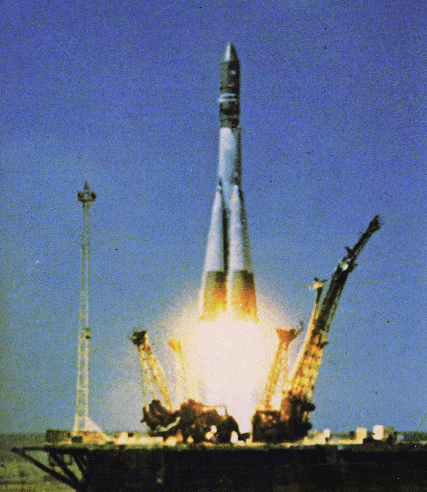

 OK, this week, not only do we have the regularly scheduled
  So
So 
 You'll notice that the countdown clock in the upper left has finally been reset. There's now
  On this date in 1959,
 The
The  OK, I generally try to avoid doing much political blogging on ATW. During the last presidential campaign I did a bit, focused solely on what candidates said about spaceflight, and I will probably take a similar tack this time around.
 The
The 

 A friend pointed out to me an article on
  On this date in 1983, the
  "If happy little bluebirds fly over the rainbow," Dororothy sang enviously in the Wizard of Oz, "why, oh, why can't I?"